
Helping scientists measure the composition and chemistry of some of the cleanest air in the world, and track how it is changing over time.
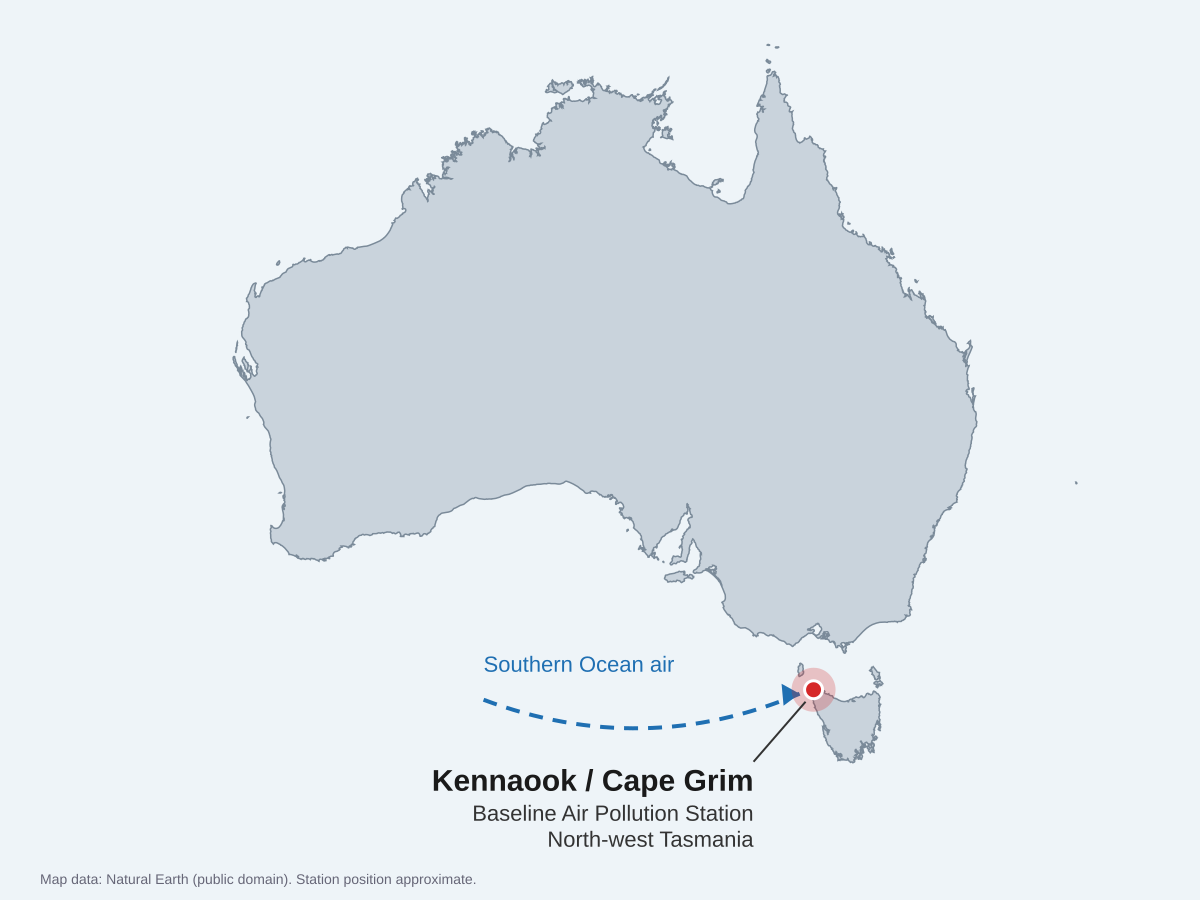

Photo: “Cape Grim DSC08448 Tasmania” by Ian Cochrane, via Wikimedia Commons, licensed under CC BY 2.0.

The customer
Our customer is an Australian Government agency responsible for scientific research and its commercial and industrial applications. It analyses and models the data from the Kennaook / Cape Grim Baseline Air Pollution Station in north-west Tasmania.
The project
The Kennaook / Cape Grim Baseline Air Pollution Station began continuous measurements in April 1976, following an Australian Government commitment to the United Nations Environment Program to study global atmospheric composition. It is one of three premier baseline stations in the World Meteorological Organization’s Global Atmosphere Watch network. When the wind arrives from the west or south-west, the air has travelled thousands of kilometres across the Southern Ocean, free of city and industrial pollution.
The station measures more than 50 greenhouse gases, as well as ozone-depleting substances, reactive gases, radon, and natural and man-made aerosols such as sea salt, mineral dust and carbon particles. Aerosols matter because they can cool or warm the atmosphere by scattering or absorbing light, or by changing how clouds form. In baseline conditions the air carries roughly 1,000 times fewer particles than Melbourne on a good day, so particle measurements here must be sensitive enough to work at extremely low concentrations.
Our contribution
Kenelec Scientific supplied TSI ultrafine condensation particle counters to support the station’s aerosol monitoring. TSI’s particle instruments measure sizes from 0.001 to 20 micrometres and are used worldwide for aerosol research, environmental studies and climate change research.
The outcome
TSI CPCs now form part of the particle monitoring at one of the world’s premier baseline stations, helping build a long-term record of aerosol concentrations in clean air.
- Tags: CPC, Ultrafine particles, TSI
Need to measure aerosols or ultrafine particles in clean-air or environmental research? Talk to the Kenelec Scientific team about particle counting solutions.
Reference to the Kennaook / Cape Grim Baseline Air Pollution Station or the use of facility imagery does not constitute or imply an endorsement, recommendation, or favoring by the Bureau of Meteorology or CSIRO.
It’s good to be in the know. Join our mailing list and let us keep you up to date on the things you want to hear about.